
The modern world rewards people who can think independently, solve complex problems, and adapt to changing situations. Traditional learning methods remain valuable, but educators increasingly recognize that students need more than memorization and standardized answers. They need opportunities to experiment, create, fail, improve, and discover solutions on their own.
This shift has brought greater attention to maker mindset learning. Rooted in hands-on exploration and creative problem-solving, the maker mindset encourages learners to build, test, refine, and innovate. It transforms students from passive consumers of information into active creators of knowledge. As schools and educational organizations expand STEAM programs, maker mindset learning is becoming a powerful tool for developing critical thinking and problem-solving abilities that extend far beyond the classroom.
Understanding the Maker Mindset
A maker mindset is more than simply building projects or using technology. It represents a way of thinking that values curiosity, experimentation, resilience, and continuous improvement. People with a maker mindset view challenges as opportunities to learn rather than obstacles to avoid.
This approach encourages learners to ask questions, explore possibilities, and test ideas through practical experience. Instead of focusing solely on getting the correct answer, maker mindset learning emphasizes understanding the process behind solving a problem. This shift helps students become more confident, adaptable, and resourceful in unfamiliar situations.
Why Problem-Solving Skills Matter More Than Ever
Today’s students will enter a workforce that looks very different from previous generations. Automation, artificial intelligence, and technological advancements continue reshaping industries across the globe. Many future careers will require employees to solve problems that do not yet exist today.
Research from organizations such as the World Economic Forum consistently identifies problem-solving and critical thinking among the most valuable future workforce skills. Employers increasingly seek individuals who can analyze situations, evaluate options, and create innovative solutions. Maker mindset learning directly supports these abilities by placing learners in situations where they must actively overcome challenges.
Rather than simply following instructions, students become responsible for finding solutions. This practical experience strengthens the cognitive processes required for effective problem-solving throughout life.
The Connection Between Making and Critical Thinking
Critical thinking involves analyzing information, evaluating evidence, identifying assumptions, and making informed decisions. These skills develop most effectively when learners engage in meaningful challenges rather than passively receiving information.
Maker mindset learning naturally creates opportunities for critical thinking because projects rarely proceed perfectly from the start. Learners must assess problems, identify causes, compare possible solutions, and determine the best course of action.
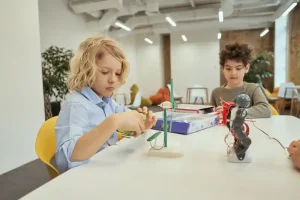
For example, a student building a simple engineering prototype may discover that the design does not function as intended. Rather than viewing the setback as failure, the student investigates what went wrong and develops alternative approaches. This cycle of observation, analysis, and revision strengthens critical thinking skills in a practical and memorable way.
Learning Through Trial and Error
One of the most valuable aspects of maker mindset learning is its acceptance of mistakes as part of the learning process. Traditional educational environments sometimes create pressure to avoid errors, but innovation often emerges through experimentation.
When students build, design, code, or create, they inevitably encounter challenges. A structure may collapse. A robot may malfunction. A design may fail to meet expectations. These moments provide powerful learning opportunities.
Instead of giving up, learners develop persistence. They evaluate what happened, gather information, and attempt new solutions. This iterative process mirrors how scientists, engineers, inventors, and entrepreneurs solve real-world problems. Over time, students learn that setbacks are not signs of inability but essential steps toward improvement.
Encouraging Curiosity and Inquiry
Curiosity serves as the foundation of innovation. People who ask questions and seek answers are often better equipped to solve complex problems. Maker mindset learning encourages curiosity by giving learners the freedom to explore ideas and pursue meaningful projects.
Rather than simply completing assignments, students become investigators. They ask why a problem exists, how a system works, and what improvements could be made. This mindset transforms learning into an active process of discovery.
Educational experts frequently emphasize that inquiry-based learning improves long-term understanding because students become personally invested in finding answers. Maker mindset learning supports this principle by allowing learners to explore challenges that spark genuine interest and engagement.
Building Confidence Through Hands-On Success
Confidence plays a significant role in problem-solving. Individuals who believe they can overcome challenges are more likely to persist when difficulties arise. Unfortunately, many students develop a fear of failure when they rarely experience opportunities to experiment independently.
Maker mindset learning helps build confidence through hands-on achievement. Each successful project reinforces the belief that effort, creativity, and persistence can produce results. Even small accomplishments contribute to a stronger sense of capability.
As learners gain experience solving problems independently, they become more willing to tackle increasingly complex challenges. This growing confidence extends beyond academic settings and influences personal, professional, and social situations throughout life.
Collaboration Strengthens Critical Thinking
Problem-solving rarely occurs in isolation. Most real-world challenges require collaboration among individuals with different perspectives and expertise. Maker mindset learning often incorporates teamwork, encouraging students to work together toward shared goals.
Collaborative projects expose learners to diverse viewpoints. Team members may propose different solutions, identify overlooked issues, or contribute unique skills. This exchange of ideas strengthens critical thinking because participants must evaluate alternatives and justify decisions.
Research consistently shows that collaborative learning environments improve analytical reasoning and communication skills. When students discuss ideas, defend their reasoning, and consider opposing perspectives, they develop a deeper understanding and stronger problem-solving abilities.
Creativity as a Problem-Solving Tool
Creativity and problem-solving are closely connected. Innovative solutions often emerge when individuals think beyond conventional approaches. Maker mindset learning encourages creative thinking by allowing learners to experiment with different materials, methods, and designs.
Rather than focusing solely on predetermined outcomes, maker activities encourage exploration of multiple possibilities. Students learn that there may be several valid solutions to a single problem.
This flexibility is particularly valuable in today’s rapidly changing world. Many modern challenges require creative responses rather than standardized answers. By nurturing imagination and innovation, maker mindset learning prepares students to address complex issues with confidence and originality.
STEAM Education and the Maker Movement
The maker movement has become closely associated with STEAM education, which integrates science, technology, engineering, arts, and mathematics. This interdisciplinary approach reflects how real-world problems often require knowledge from multiple fields.
Maker mindset learning supports STEAM by encouraging students to apply concepts across disciplines. A project might involve scientific investigation, mathematical calculations, engineering design, artistic creativity, and technological tools simultaneously.
This integrated learning experience helps students understand how different areas of knowledge connect. More importantly, it develops the ability to transfer skills between contexts, a key component of effective problem-solving and critical thinking.
Developing Adaptability and Resilience
Adaptability has become increasingly important in a world characterized by rapid technological and social change. Individuals who can adjust to new circumstances often perform better in both educational and professional settings.
Maker mindset learning promotes adaptability by exposing students to uncertainty. Projects rarely follow perfectly predictable paths, requiring learners to adjust strategies as new information emerges.
At the same time, repeated experiences with challenges build resilience. Students learn to remain focused despite setbacks and continue working toward solutions. These qualities contribute significantly to long-term success and effective decision-making.
Real-World Applications of Maker Mindset Skills
The benefits of maker mindset learning extend far beyond classrooms and makerspaces. The skills developed through hands-on projects apply directly to everyday life and future careers.
Engineers use iterative design processes to improve products. Entrepreneurs test business ideas and adapt based on feedback. Healthcare professionals solve unexpected challenges. Scientists conduct experiments and refine hypotheses. In each case, success depends on many of the same abilities cultivated through maker experiences.
By practicing problem-solving in authentic contexts, students develop transferable skills that remain valuable throughout their lives. They become better equipped to navigate uncertainty, identify opportunities, and contribute innovative solutions to society.
The Role of Educators and Learning Environments
Teachers play a critical role in fostering a maker mindset. Rather than acting solely as information providers, they become facilitators who guide exploration and encourage experimentation.
Effective maker-centered environments prioritize curiosity, creativity, and reflection. Students are given opportunities to ask questions, take risks, and learn from mistakes without fear of excessive judgment. These conditions create a culture where innovation can thrive.
Educators who embrace maker mindset learning often report higher student engagement, stronger motivation, and deeper understanding of complex concepts. The emphasis shifts from completing tasks to developing meaningful skills and insights.
Future Implications of Maker Mindset Learning
As technology continues transforming society, the importance of human-centered skills will only increase. While machines can automate routine tasks, creativity, critical thinking, and complex problem-solving remain uniquely valuable human strengths.
Maker mindset learning prepares students for this future by emphasizing the abilities that technology cannot easily replace. It encourages independent thought, adaptability, collaboration, and innovation.
Educational systems worldwide are increasingly recognizing the need to cultivate these competencies. As a result, maker-centered learning approaches are likely to play an even greater role in preparing future generations for success.
Conclusion
The maker mindset offers far more than opportunities to build projects or explore technology. It develops a way of thinking that empowers learners to approach challenges with curiosity, confidence, and creativity. Through experimentation, collaboration, and continuous improvement, students strengthen the problem-solving and critical thinking skills that are essential in today’s world.
Maker mindset learning transforms mistakes into learning opportunities and encourages individuals to become active participants in their own education. By fostering resilience, adaptability, and innovation, it equips learners with capabilities that extend far beyond academic achievement. As STEAM education continues evolving, the maker mindset will remain a powerful framework for preparing future-ready thinkers and problem-solvers.
FAQs
1. What is maker mindset learning in education?
Maker mindset learning is an educational approach that encourages hands-on creation, experimentation, and problem-solving while developing creativity, critical thinking, and resilience through active learning experiences.
2. How does maker mindset learning improve critical thinking?
It improves critical thinking by requiring learners to analyze problems, test solutions, evaluate outcomes, and make informed decisions throughout the design and creation process.
3. Why is failure important in maker mindset learning?
Failure provides valuable feedback and learning opportunities. Students learn to identify mistakes, adjust strategies, and develop persistence while working toward successful solutions.
4. How does maker mindset learning support STEAM education?
It integrates science, technology, engineering, arts, and mathematics through practical projects that require interdisciplinary thinking and real-world problem-solving skills.
5. Can maker mindset learning benefit students outside technical fields?
Yes. The skills developed through maker mindset learning, including creativity, collaboration, adaptability, and critical thinking, are valuable across virtually every career and life situation.